DI Water Systems for Labs & Laboratory Water Treatment
Mueller Water designs, installs, and services laboratory water systems across Texas — reverse osmosis, mixed-bed deionization, and portable DI tank exchange producing Type I, II, and III water to ASTM D1193 and CLSI grades. We size against the water your methods actually require, which for most labs means producing bulk Type III cheaply and polishing small volumes to ultrapure only where it is needed.
Lab water is not one thing. The water that feeds a glassware washer and the water that goes into an HPLC mobile phase are separated by four orders of magnitude in purity, and treating them as a single requirement is how labs end up either contaminating results or paying to make ultrapure water for an autoclave.
Mueller Water builds DI water systems for labs across Texas — clinical and hospital laboratories, university and research benches, environmental and contract testing, and manufacturing QC. We have supplied laboratory water from our Houston, Austin, San Antonio, and Dallas–Fort Worth branches since 1969.
Laboratory Water Grades: Type I, II & III
Lab water grades are defined by ASTM D1193, with a parallel standard from CLSI for clinical laboratories. Knowing which grade each application actually needs is the single biggest lever on system cost:
| Grade | Resistivity | Typical technology | Used for |
|---|---|---|---|
| Type I (ultrapure) | 18.2 MΩ-cm | RO + mixed-bed polishing, often with UV and 0.2 µm final filter | Trace metals, HPLC, mass spec, cell culture, molecular biology |
| Type II (high purity) | > 1 MΩ-cm | RO + deionization | General analytical work, reagent and media prep, bench chemistry |
| Type III (general lab) | > 4 MΩ-cm (varies by standard) | RO or single-pass DI | Glassware rinse, autoclave and steriliser feed, water baths, feed to higher grades |
Most laboratories need at least two of these. The efficient design is almost always a central system producing Type III in bulk, with mixed-bed polishing at the specific benches that require Type I — not a single system built to the strictest specification in the building.
Ways to Get DI Water Into a Lab
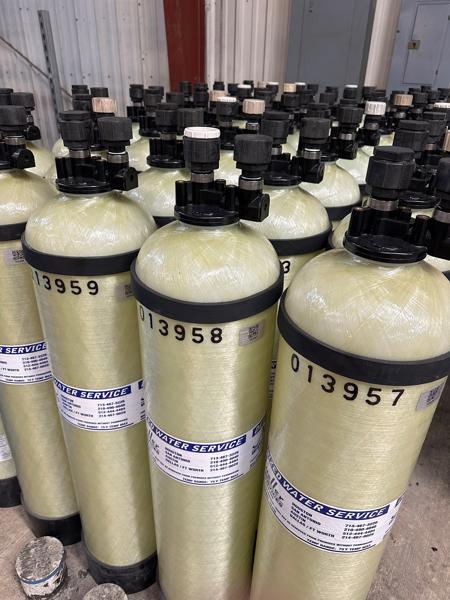
Portable DI Tank Exchange
The most common arrangement for laboratories, and usually the cheapest below roughly 5,000–10,000 gallons per day. Charged DI tanks are delivered, plumbed to your point of use with a resistivity monitor, and swapped on schedule; exhausted tanks are regenerated off-site. No capital cost, no acid or caustic on the premises, no waste neutralisation, and no one on staff has to learn resin chemistry. Cabinet-size tanks suit a single bench; compact and standard tanks serve whole departments. See DI water tank exchange service for tank sizes and scheduling.
Permanent RO + DI Systems
For higher-volume facilities, a permanent reverse osmosis system followed by deionization produces bulk water continuously at lower marginal cost. RO removes 95–99% of dissolved solids, so the DI resin downstream handles a small fraction of the original ionic load and lasts far longer. This is the standard configuration wherever Type I water is needed in quantity.
Electrodeionization (EDI)
EDI sits downstream of RO and produces continuous high-purity water with no regeneration chemicals at all, using an electric field instead. Higher capital cost, lower operating cost, and no exchange schedule to manage — a good fit for labs that need steady Type I production and want to remove consumables from the equation.
Pretreatment: Why Lab DI Systems Fail Early
The most expensive mistake in laboratory water is feeding municipal water straight into DI. Two things in Texas tap water attack a DI system directly:
- Chlorine and chloramine oxidise DI resin. They degrade the resin beads themselves, permanently reducing capacity and shedding organics into your product water. Activated carbon filtration ahead of the DI stage is mandatory, and because most Texas cities use chloramine rather than free chlorine, it needs to be catalytic carbon with adequate contact time.
- Hardness consumes cation capacity disproportionately. Calcium and magnesium load the cation resin far faster than the ions you are actually trying to remove. Softening ahead of DI typically extends tank life by 50% or more, and on Edwards Aquifer water the difference is larger still.
On high-alkalinity supplies, dealkalization ahead of the DI train is worth evaluating as well: bicarbonate loads anion resin heavily, and removing it upstream with cheap brine regeneration means far fewer regenerations of expensive DI resin downstream.
Laboratory Types We Supply
- Clinical & hospital laboratories — CLSI-grade reagent water for analysers, sterile processing support, and dialysis pretreatment. See hospital water treatment.
- University & research laboratories — Type I water for molecular biology, analytical chemistry, and instrument feed across multi-bench facilities.
- Environmental & contract testing — trace-level analytical work where blank contamination invalidates results.
- Pharmaceutical & biotech — USP Purified Water pretreatment, media preparation, and cleaning validation. See pharmaceutical water treatment.
- Manufacturing QC laboratories — bench water supporting production testing in semiconductor, electronics, food, and chemical plants.
- Calibration & metrology laboratories — consistent low-TDS water where measurement repeatability depends on the reagent water being identical batch to batch.
Specifying a Lab Water System
Four things determine the design. If you can supply them, we can size the system without a site visit; if you cannot, we will work through them with you:
- Required grade per application — which benches need Type I and which are fine on Type III. This is where most of the cost is decided.
- Daily volume and peak draw — total litres or gallons per day, plus the highest instantaneous demand (a glassware washer fill is usually the peak).
- Feedwater analysis — hardness, TDS, alkalinity, chlorine or chloramine, silica, and TOC. Your municipality’s annual report is a reasonable starting point; we can pull it for you.
- Storage and distribution — whether water is used at the point of production or needs a loop, since ultrapure water degrades in storage and a recirculating loop with UV is often required.
Laboratory Water Service Across Texas
Mueller Water supplies and services laboratory water systems from four Texas branches, with same-day or next-day exchange as the standard service level:
- Houston: 1500 Sherwood Forest St, Houston, TX 77043 · (713) 467-3226 — Texas Medical Center, Ship Channel industrial labs
- San Antonio: 8957 E IH 10, Converse, TX 78109 · (210) 490-4040 — UT Health, military and federal laboratories
- Austin: 1512 Central Commerce Circle, Pflugerville, TX 78660 · (512) 444-4404 — UT Austin, biotech and semiconductor labs
- Dallas / Fort Worth: 1825 High Prairie Rd #B, Grand Prairie, TX 75050 · (214) 467-0029 — UT Southwestern, hospital and aerospace QC labs
Toll-free: 1-888-678-6411 · Mon–Fri 7:00 AM – 4:00 PM CT. We also service laboratory water systems we did not install — see diagnostics and repair.
Laboratory Water & DI System FAQs
What kind of DI water system does a lab need?
Should I buy a DI system or use tank exchange?
What is the difference between Type I, II, and III lab water?
Why does my lab water resistivity drop so quickly?
Do I need pretreatment before a lab DI system?
How much lab water does a typical facility use?
Can you service a lab water system you did not install?
Recommended Mueller Products: