Distillery Water Treatment Systems in Texas
Mueller Water designs, installs, and services water treatment for distilleries across Texas — catalytic carbon for chlorine and chloramine removal, softening for cook and condenser water, iron and hydrogen sulfide removal for well supplies, and reverse osmosis for proofing water. Each stream in a distillery needs different water, and we size the treatment train against a measured source-water analysis rather than a standard package.
A bottle of spirits is mostly water. After distillation strips the wash down to high-proof spirit, proofing water brings it back to bottle strength — and that water goes into the product with no further treatment of any kind. Upstream, cook water shapes fermentation, condenser water determines how long your still stays clean, and cleaning water touches every surface the spirit will later contact.
Mueller Water has designed and serviced water treatment for distilleries across Texas since 1969, from our four branches in Houston, Austin, San Antonio, and the Dallas–Fort Worth region. We build the pretreatment train around your actual water, your production volume, and which streams matter most to your process.
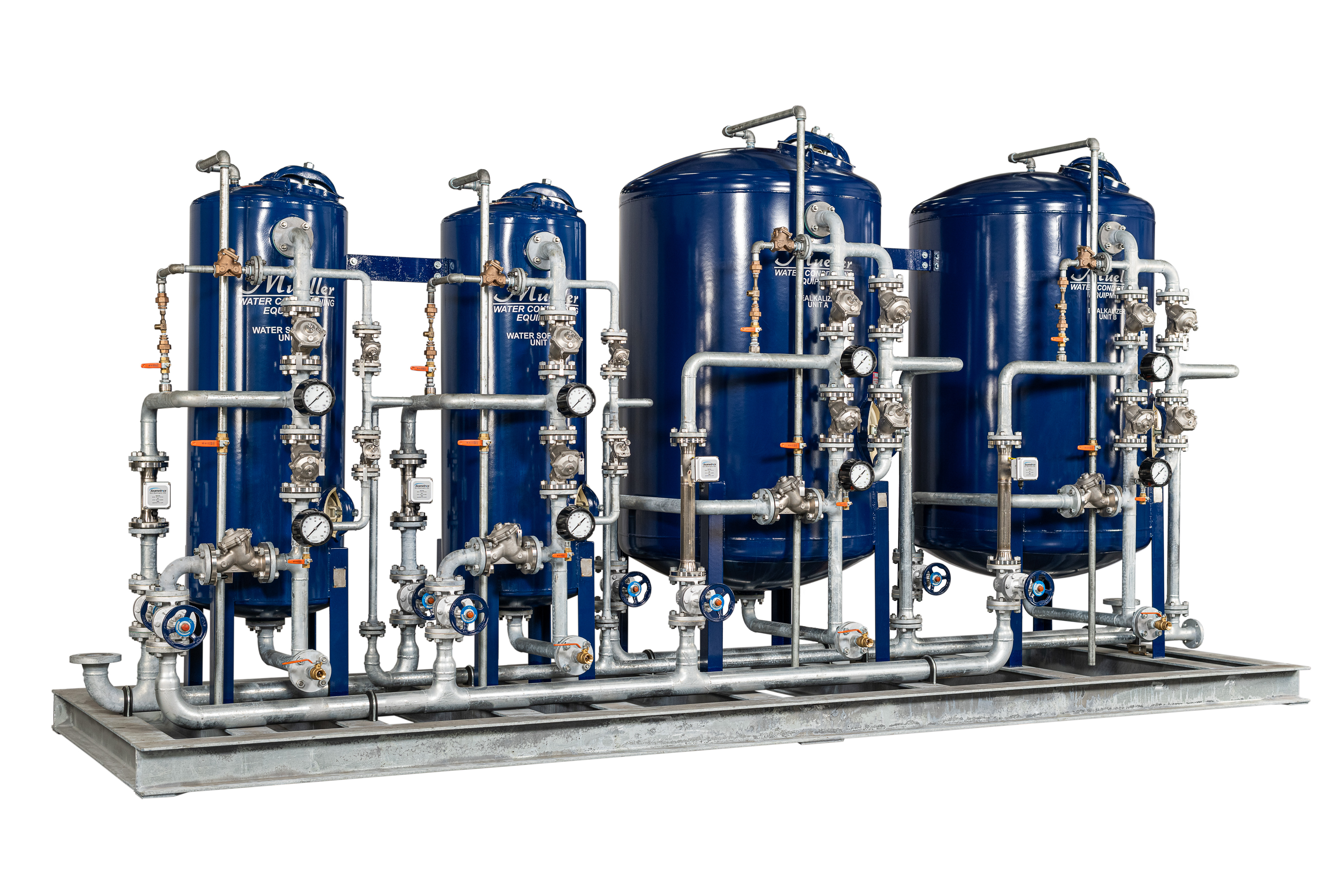
The Four Water Streams in a Distillery
Distilleries are unusual among beverage producers in that they need genuinely different water for different jobs. Treating everything to the strictest specification wastes capital; treating everything to the loosest one costs you product. The four streams:
1. Cook & Mash Water
The water that goes into the mash tun with your grain. It must be free of chlorine and chloramine, because both react with grain phenolics to form chlorophenols that survive fermentation and distillation. Hardness matters less here than it does for a brewery — most mineral character is left behind in the still — but calcium does support yeast health and enzyme activity, so stripping the water completely is not the goal either. High alkalinity is the more common problem, since it pushes mash pH up and fights the acid additions used to correct it.
2. Proofing Water
The stream with the least margin for error. Proofing water is added after distillation and after aging, and can represent a third or more of the finished bottle. It receives no heat, no filtration, and no further processing. Dissolved solids in proofing water cause haze and flocculation — particularly in non-chill-filtered spirits, where reducing proof lowers the alcohol’s capacity to hold fatty acids and esters in solution, and minerals give precipitation something to form around. Carbonate and bicarbonate can read as soapy or chalky in the glass. Reverse osmosis is the standard answer, and because proofing volume is small relative to plant total, an RO skid sized for it alone is usually modest.
3. Condenser & Cooling Water
The largest water user in most distilleries by a wide margin, and the one most often left untreated. A still condenser can pull tens of gallons per minute while running. Hard water deposits scale on the condenser tubes, which throttles heat transfer, lengthens run times, and eventually forces aggressive chemical cleaning that shortens equipment life. Softening the cooling stream is usually the highest-return single treatment in the plant, and it is frequently missed because operators size treatment against product volume rather than total water use.
4. Cleaning & CIP Water
Hard water reduces detergent effectiveness and leaves mineral film on tanks, lines, and fermenters — film that gives bacteria and wild yeast a surface to colonize. Softened water improves cleaning chemistry performance and cuts chemical consumption. For final rinses, dechlorinated water prevents chlorine residue from carrying into the next batch.
Typical Distillery Pretreatment Train
A representative configuration for a Texas distillery on municipal water. Each stage exists because something specific fails without it:
| Stage | What it removes | What fails without it | Streams served |
|---|---|---|---|
| Sediment / multimedia filtration | Suspended solids, turbidity, pipe scale | Fouls carbon and RO membranes downstream | All |
| Catalytic activated carbon | Chlorine, chloramine, organics, taste and odor | Chlorophenol off-aromas in the finished spirit | Cook, proofing, CIP |
| Iron / manganese / H₂S filtration | Iron, manganese, hydrogen sulfide | Metallic and sulfur notes, staining (well supplies) | All, where present |
| Water softening | Calcium and magnesium hardness | Condenser and heat-exchanger scale, poor CIP | Cooling, CIP, cook, RO feed |
| Reverse osmosis | 95–99% of dissolved solids and alkalinity | Haze and mineral flavor in proofed spirit | Proofing |
Softening ahead of RO is not optional — hardness scales membranes and shortens their life sharply. See reverse osmosis systems and commercial water softeners for the equipment we build for each stage.
Texas-Specific Distillery Water Problems
Distillery water treatment specified out of state frequently underperforms here, for three reasons that are particular to Texas:
- Chloramine, not free chlorine. Most major Texas municipalities disinfect with chloramine, which is far more stable than free chlorine and passes straight through standard activated carbon sized for chlorine contact time. Removing it requires catalytic carbon and a longer empty-bed contact time. A carbon system spec’d for a chlorinated city will let chloramine through, and the chlorophenols show up in the spirit months later.
- Edwards Aquifer hardness. Central and South Texas source water is significantly harder than most of the country because of the limestone geology. Condenser scaling develops faster here, and softener sizing that works elsewhere runs short on capacity.
- Hill Country well chemistry. Distilleries on well water frequently face iron, manganese, hydrogen sulfide, and high alkalinity together — a combination that needs a sequenced treatment train, not a single filter. Well chemistry also shifts seasonally, so it needs periodic retesting rather than one analysis at commissioning.
Where alkalinity is the dominant problem, dealkalizer water treatment removes it directly and is often cheaper than sending the whole supply through RO. For wells, well water treatment covers the iron, manganese, and hydrogen sulfide side.
Steam, Boilers & Spent Stillage
Steam-heated stills add a boiler to the plant, and a boiler adds its own feedwater requirements. Alkalinity and hardness in boiler makeup drive blowdown, fuel cost, and condensate line corrosion — all of which are treatable upstream. Distilleries running continuous or high-volume batch stills should expect boiler feedwater treatment to be a real part of the design rather than an afterthought.
On the back end, spent stillage and backset carry high BOD and suspended solids. Many Texas municipalities bill distilleries on discharge strength, and some require pretreatment before the effluent enters the sewer. That is a separate design problem from incoming water and is worth scoping early, because discharge limits can constrain how much you are permitted to produce.
Sizing Water Treatment to Production
Sizing follows peak flow, not average consumption. A distillery that uses a modest daily volume can still need substantial instantaneous capacity if the mash tun fills quickly or the condenser runs hard during a distillation. Three numbers drive the design:
- Peak flow rate — the highest simultaneous demand across cook fill, condenser, and CIP, in gallons per minute. This sets vessel diameter and service flow.
- Daily and weekly volume — total throughput including cooling and cleaning, which sets softener capacity and regeneration frequency.
- Source water analysis — hardness, alkalinity, chloride, iron, manganese, TDS, and disinfectant type. Without it, any sizing is a guess.
We size twin-tank softeners for any distillery that cannot pause production for regeneration, which is most of them once the condenser is on treated water. If you are still planning the facility, we would rather look at the water before the equipment layout is fixed — treatment placed into a finished plant almost always costs more than treatment designed into it.
Distillery Water Treatment Service Across Texas
Mueller Water services distilleries from four Texas branches, with same-day or next-day response as the standard service level:
- Houston: 1500 Sherwood Forest St, Houston, TX 77043 · (713) 467-3226
- San Antonio: 8957 E IH 10, Converse, TX 78109 · (210) 490-4040
- Austin: 1512 Central Commerce Circle, Pflugerville, TX 78660 · (512) 444-4404
- Dallas / Fort Worth: 1825 High Prairie Rd #B, Grand Prairie, TX 75050 · (214) 467-0029
Toll-free: 1-888-678-6411 · Mon–Fri 7:00 AM – 4:00 PM CT. Also see our brewery water treatment page if you operate a combined brewery and distillery, and food and beverage water treatment for related production applications.
Distillery Water Treatment FAQs
What water treatment does a distillery need?
Why does proofing water need reverse osmosis?
Does chlorine really survive distillation?
How much water does a distillery actually use?
Do I need to treat well water differently than city water?
Can the same system handle cook water, proofing water, and cooling water?
What does a distillery water treatment system cost?
Recommended Mueller Products: