Why a Heavier-Built Industrial Water Treatment System Pays for Itself: The Case for Flanged-and-Welded, Stainless Steel Construction
For most industrial process water applications, a heavy-duty water treatment system — thicker tank shells and heads, stainless steel flanged-and-welded manifold piping, actuated valves, and stainless steel internals — is the lower total-cost choice over a 15-to-25-year service life, even though it carries a higher purchase price than a galvanized, threaded, plastic-internal unit. The savings come from three places: longer service life, lower and more predictable maintenance, and — the factor that dwarfs the others in a continuous process plant — far less downtime. Lighter-duty construction can still be the right answer for intermittent-duty, low-pressure, non-critical applications where downtime costs little.
When a plant manager or engineer specifies an industrial water softener, demineralizer, or filtration system, the purchase decision often comes down to a single line on a quote: the price. Two units may look similar on a datasheet — same flow rate, same resin volume, same footprint — yet differ by tens of thousands of dollars. The difference almost always lives in the construction: tank wall thickness, the metallurgy of the piping and internals, and how everything is connected.
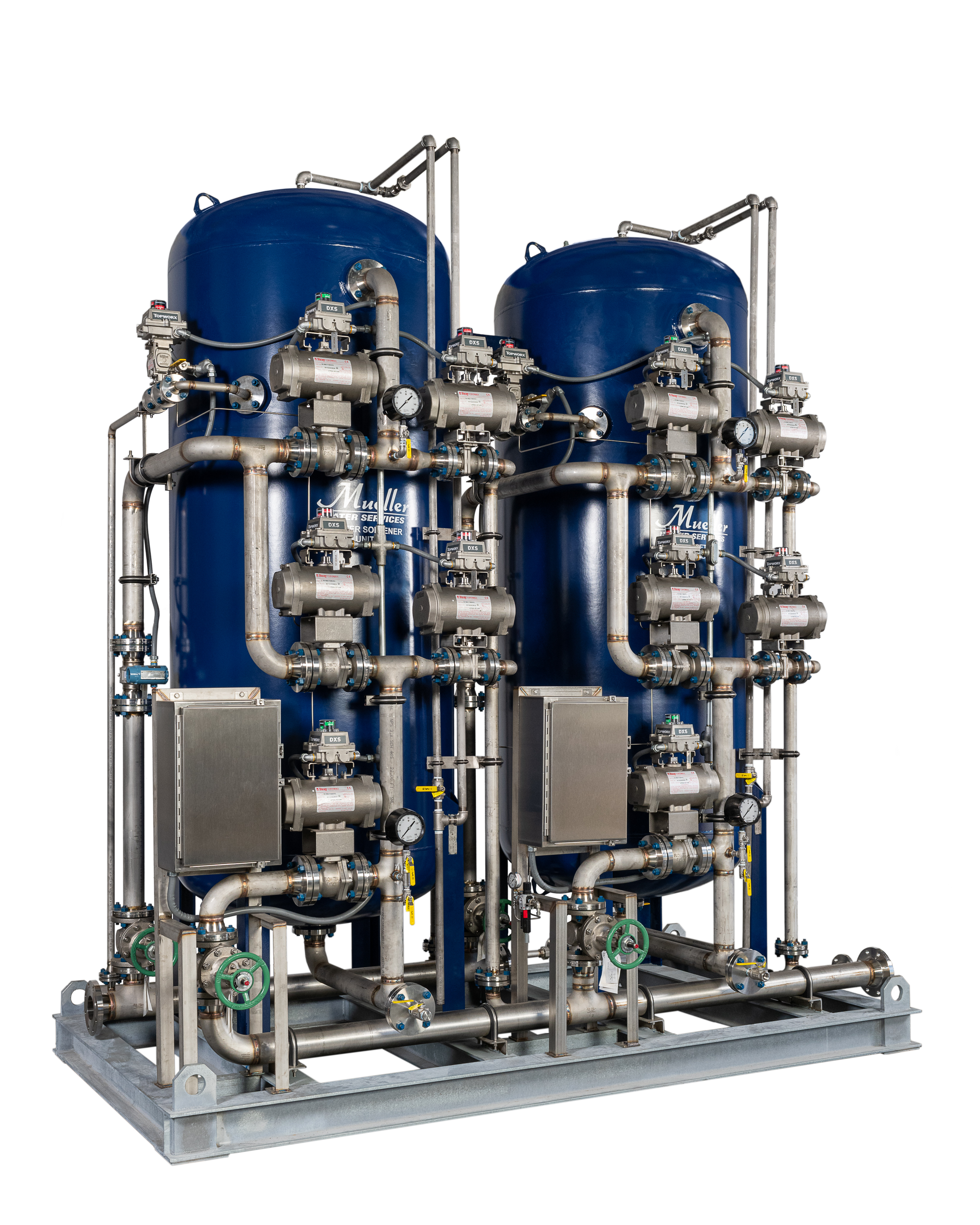
At Mueller Water Conditioning, we build both lighter-duty and heavy-duty configurations because different applications call for different solutions. But for most industrial process water customers, the heavier design — thicker tank shells and heads, stainless steel flanged-and-welded manifold piping, actuated valves, and stainless steel internals — is the smarter long-term investment. Here's why.
The Real Cost of an Industrial Water System Isn't the Purchase Price
Industrial equipment is judged over its service life, not at the moment of purchase. The total cost of ownership includes the initial capital, plus every pound of salt consumed in regeneration, every maintenance hour, every replacement part, and — most expensively — every hour the system is down and the process behind it is starved for treated water.
A lighter-duty unit built with galvanized tanks, threaded connections, and PVC or plastic internals can carry a lower sticker price. But over a 15-to-25-year service life, the heavier-built stainless system frequently wins on total cost, often by a wide margin. The savings come from three places: longevity, reduced maintenance, and — the one that dwarfs the others in a continuous process plant — avoided downtime.
Longevity: Building for Decades, Not Years
Thicker tank shells and heads
A pressure vessel's working life is largely a function of its wall thickness and corrosion allowance. Thicker side shells and heads give the tank more material to work with against internal corrosion, cyclic pressure fatigue from regeneration and service cycles, and the mechanical stress of years of operation. A vessel built with a generous corrosion allowance and heavier plate simply has more margin before wall thinning becomes a structural or safety concern.
Lighter vessels reach their condemnation thickness sooner. When that happens, you're not making a repair — you're replacing the heart of the system, often with a long lead time and a fully shut-down process.
Stainless steel where it matters
Galvanized steel relies on a sacrificial zinc coating. That coating is consumed over time, and once it's gone — especially in the wet, mineral-laden, and sometimes chemically aggressive environment inside a water treatment system — the base steel corrodes quickly. Threaded galvanized connections are particularly vulnerable: the threading cuts through the protective coating at the exact point where the joint is most stressed and most exposed to leakage.
Stainless steel manifold piping and internals don't depend on a coating. The corrosion resistance is inherent to the metal. Stainless distributors, laterals, and internals hold their shape and integrity through thousands of backwash and regeneration cycles, where plastic internals can warp, crack, embrittle, or break under thermal and mechanical cycling. In a brine-rich softener environment, that resistance to chloride and mechanical stress translates directly into years of additional service.
Lower Maintenance and Repair Costs
Flanged and welded vs. threaded connections
How a system is connected determines how it ages and how it's serviced. Threaded connections are a known weak point in industrial piping. Every thread is a potential leak path, a stress concentration, and a corrosion initiation site. Over time, thermal cycling and vibration loosen threaded joints, and the only fix is often to break down a section of piping, re-cut or re-tape threads, and reassemble — labor-intensive work that frequently requires draining and isolating the system.
A flanged-and-welded stainless manifold behaves differently. Welded joints are continuous and leak-free by design, with no threads to corrode or back out. Flanged connections at valves and serviceable points let a technician isolate, remove, and reinstall a component cleanly with a bolt pattern and a gasket, rather than wrestling with seized threaded unions. The result is fewer leaks over the life of the system and dramatically faster, cleaner service when maintenance is needed.
Stainless steel valves and actuators vs. carbon steel
A water treatment system's valves cycle constantly — every service run, backwash, and regeneration drives them open and closed. In that wet, mineral-laden, and brine-exposed environment, the valve and actuator metallurgy determines how long the automation stays reliable.
Carbon steel valve bodies and actuator hardware corrode in this service. Rust forms on bodies, stems, and fasteners; pitting roughens sealing surfaces and accelerates seat and packing wear; and corroded actuator components bind, stick, or fail to stroke fully. Each of those failures throws off the regeneration sequence, producing off-spec water, wasted salt, and resin damage — and each repair means isolating the system to rebuild or replace the valve.
Stainless steel valve bodies and actuators don't depend on a coating or paint to survive that environment. Their corrosion resistance is inherent, so sealing surfaces stay clean, stems and packing wear slowly, and actuators continue to stroke smoothly and seat fully cycle after cycle. The automation executes the same precise sequence every time, which protects the resin bed, holds water quality consistent, and eliminates a whole category of corrosion-driven maintenance events. The reliability of the automation is only as good as the metal it's built from.
Predictability of spend
Heavy-duty stainless systems fail less often and fail more predictably. That lets a maintenance department plan around scheduled inspections and component swaps rather than reacting to surprise leaks and emergency repairs. Predictable maintenance is cheaper maintenance — you avoid overtime labor, expedited-freight charges on parts, and the cascade of problems that follow an unplanned failure.
The Reason That Outweighs the Rest: Downtime
For a continuous industrial process — a boiler feedwater system, a cooling tower makeup loop, a manufacturing line, a power plant, a refinery — the water treatment system is not a standalone asset. It's a utility the entire operation depends on. When it goes down, the process it feeds often goes down with it.
This is where the economics of construction quality become overwhelming. The cost of a leaking threaded joint isn't the price of a fitting; it's the production lost while the line is offline. The cost of a corroded-through galvanized tank isn't just the replacement vessel; it's the weeks of lead time during which the plant is running on temporary measures or not running at all. In many facilities, a single day of unplanned downtime costs more than the entire price difference between a light-duty and a heavy-duty system.
A heavy-duty stainless, flanged-and-welded, actuated system is engineered to minimize exactly these events. Fewer leak paths, corrosion-resistant materials, robust vessels, and automated reliability all push the same direction: the system keeps running, and so does everything downstream of it.
When duplex or redundant trains are configured — two units that can alternate or back each other up — a well-built system can be serviced without ever taking the process offline. Heavy-duty construction makes that redundancy meaningful, because each train is reliable enough to carry the load while its twin is maintained.
Additional Advantages of the Flanged-and-Welded Stainless Configuration
Beyond the three pillars above, the heavier configuration brings a set of practical benefits worth weighing:
- Higher and more consistent water quality. Corrosion products from galvanized steel and degrading coatings can shed into the treated water stream. Stainless internals and piping keep the water cleaner, which matters enormously for sensitive downstream processes like high-pressure boilers, electronics manufacturing, and pharmaceutical or food-and-beverage production.
- Higher pressure and temperature tolerance. Thicker vessels and welded stainless piping handle higher operating pressures and warmer water with more margin, expanding the range of applications the system can serve and reducing the risk of failure under upset conditions.
- Better resale and asset value. A robustly built stainless system retains value far longer than a galvanized unit nearing the end of its coating life. It's an asset on the balance sheet, not a liability waiting to be replaced.
- Safer operation. Pressure vessels and high-flow piping carry real risk if they fail. Heavier construction with appropriate corrosion allowance and welded joints reduces the likelihood of a sudden failure that could endanger personnel or facilities.
- Easier inspection and code compliance. Welded, flanged stainless systems are straightforward to inspect, document, and certify against ASME and other applicable standards — important in regulated industries and for insurance purposes.
- Cleaner appearance and serviceability. A stainless skid-mounted system with a logically arranged manifold is simply easier for technicians to understand, access, and service safely, which compounds every maintenance advantage already described.
Matching the Build to the Application
None of this means a galvanized, threaded system is never the right answer. For intermittent-duty, low-pressure, non-critical applications where budget is the dominant constraint and downtime carries little cost, a lighter configuration can be entirely appropriate — and we build those too.
The decision should be driven by the role the system plays. Ask: How critical is treated water to my process? What does an hour of downtime actually cost? How aggressive is my water chemistry? How long do I expect this asset to serve? For most industrial process applications, honest answers to those questions point toward the heavier, flanged-and-welded stainless build.
The Bottom Line
A lower purchase price on a lighter-duty system is real, but it's only the first number in a much longer equation. Over the life of the equipment, thicker tank shells and heads, stainless steel manifold piping, actuated valves, and stainless internals deliver a longer service life, lower and more predictable maintenance costs, and — most importantly — far less downtime for the process that depends on them.
For industrial customers running critical, continuous, or high-value operations, the heavy-duty flanged-and-welded stainless configuration isn't the expensive option. Over the years it serves, it's usually the cheapest one.
Mueller Water Conditioning, Inc. designs and builds custom industrial water treatment systems — softeners, filters, demineralizers, and more — engineered to match the duty and reliability requirements of your process.
Contact Us
Call 1-888-678-6411 or request a quote to discuss the right configuration for your application.