Water Softeners and Evaporation Credits for Commercial Cooling Towers
What the numbers actually look like — based on a real operating scenario.
| Client: | Commercial Building Owner |
| Location: | Houston, Texas (Harris County) |
| Project: | Water Softening and Evaporation Credit Analysis for a 500-Ton Cooling Tower |
| Industry: | Commercial Real Estate / HVAC |
Scenario This Case Study Is Based On
All data, figures, and calculations in this document are derived from the following specific operating scenario. Results for other systems will vary based on tower size, raw water hardness, operating hours, and local utility rates.
- Facility: Commercial building — City of Houston, Harris County, TX
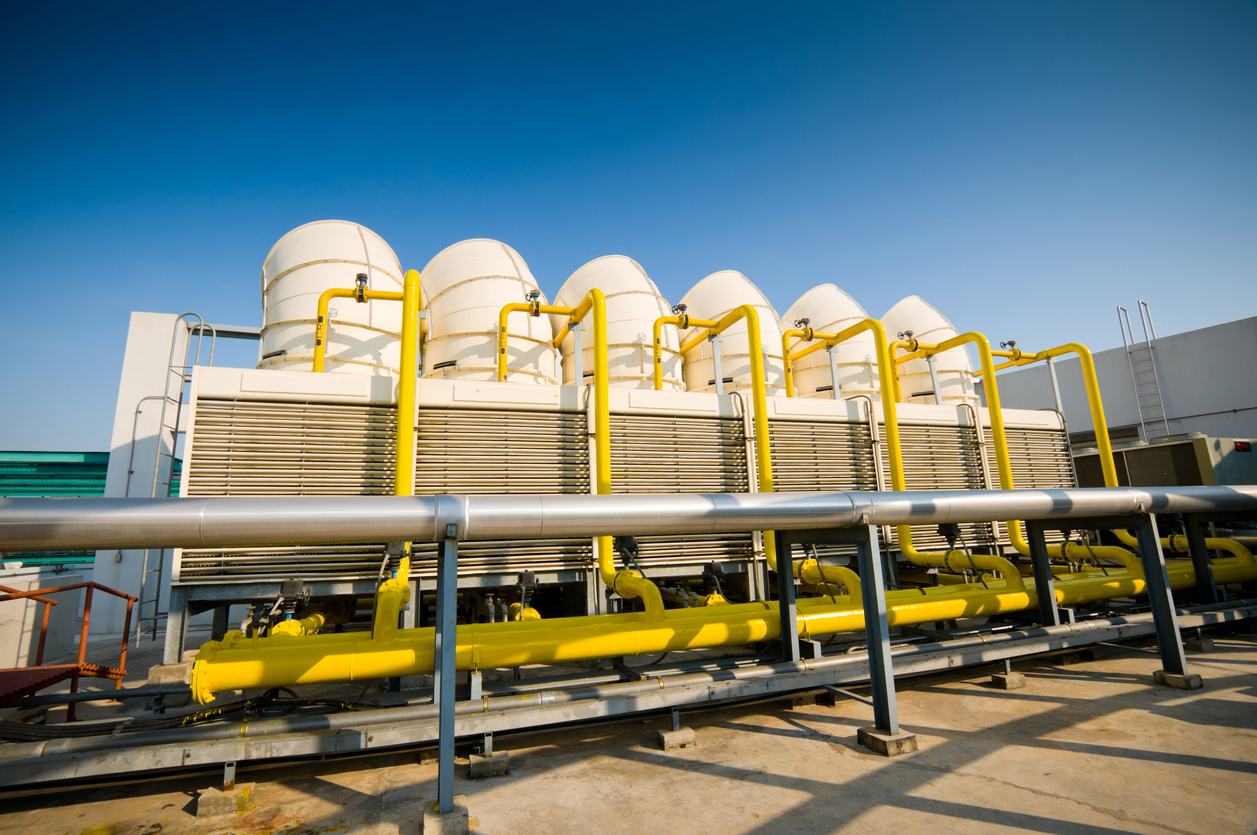
- Tower: 500-ton cooling tower
- Raw water hardness: 8 GPG (Very Hard)
- Makeup water: 9,000 GPD (metered actual)
- Makeup line: 1.5" Schedule 40
- Water rate: $8.24/kgal
- Wastewater rate: $10.38/kgal (City of Houston commercial tariffs, effective April 1, 2026)
Part 1: The Hard Water Problem
At 8 GPG, Houston's municipal supply is classified as Very Hard. Every gallon of makeup water that evaporates from the cooling tower leaves its dissolved calcium and magnesium behind. Those minerals do not evaporate — they concentrate in the basin with each cycle.
This buildup is measured as Cycles of Concentration (CoC). Without softening, this tower cannot safely exceed CoC 2.5 before scale formation becomes severe. At that point, circulating water reaches 20 GPG and calcium carbonate begins precipitating directly onto condenser tubes, fill media, and basin surfaces. Operators manage this by blowing down — draining concentrated water and replacing it with fresh makeup, wasting both the water and the chemicals already in the system.
The Energy Cost of Scale
Scale is among the worst thermal conductors in industrial systems. Even a thin deposit on condenser tube surfaces forces the chiller to consume significantly more electricity to reject the same heat load. The table below uses this building's 500-ton chiller at 0.60 kW/ton running 6,500 hours per year.
| Scale Thickness | Efficiency Loss | Extra kWh/Year | Annual Extra Cost |
|---|---|---|---|
| 1/32" (early deposit) | 10–12% | 195,000 | $16,575 |
| 1/16" | 18–22% | 330,000 | $28,050 |
| 1/8" | 30–35% | 495,000 | $42,075 |
| 1/4" | 40–45% | 637,500 | $54,188 |
| 500-ton chiller at 0.60 kW/ton · 6,500 hrs/yr · $0.085/kWh | |||
Scale does not appear as a line item on a utility bill. The penalty is embedded in aggregate electricity charges and compounds silently each season. It only becomes visible when a service technician finds fouled tubes or when the tube bundle fails years ahead of schedule.
Part 2: How a Water Softener Changes the Numbers
The Mechanism
A water softener uses ion exchange to replace calcium and magnesium with sodium before makeup water enters the tower. Sodium does not form scale. With softened makeup, this tower can safely operate at CoC 10 or higher — eliminating scale formation entirely and dramatically reducing blowdown.
Water Balance — This Scenario
Evaporation is fixed at 5,400 GPD by the heat load and cannot be reduced through any water treatment measure. All water savings come from reduced blowdown.
| No Softener — CoC 2.5 | With Softener — CoC 10 | |
|---|---|---|
| Daily makeup | 9,000 GPD | 6,000 GPD |
| Daily evaporation | 5,400 GPD | 5,400 GPD |
| Daily blowdown to sewer | 3,600 GPD | 600 GPD |
| Circulating hardness | 20 GPG | ~0 GPG |
| Annual makeup (271 days) | 2,439,000 gal | 1,626,000 gal |
| Annual blowdown to sewer | 975,600 gal | 162,600 gal |
| Water saved annually | — | 813,000 gal |
Chiller Energy Recovery
At CoC 2.5 without softening, this tower circulates 20 GPG water — producing approximately 8% efficiency loss on the 500-ton chiller. The recovery calculation:
- Efficiency loss at 20 GPG: ~8% → 300 kW × 8% = 24 kW of wasted power
- Excess energy over 6,500 operating hours: 156,000 kWh per year
- Cost at $0.085/kWh: $13,260 per year — recovered in full with softening
Chemical Program
| Treatment | Without Softener | With Softener |
|---|---|---|
| Scale inhibitor | Heavy continuous dose | Eliminated |
| Dispersant | Required | Greatly reduced or eliminated |
| Corrosion inhibitor | Standard | Standard — adjusted for sodium |
| Biocide | Standard | Standard — cleaner surfaces aid efficacy |
| Annual acid descaling | 1–2× per year required | Eliminated |
| Est. annual chemical savings | — | $11,000 – $18,000 |
Equipment Life
| Component | Without Softener | With Softener |
|---|---|---|
| Condenser tubes | Replacement at 10–12 yrs; scale pitting and under-deposit corrosion | 20+ year design life; no pitting |
| Fill media | Scaling restricts airflow; early replacement | Design life maintained |
| Basin / nozzles | Nozzle blockage; increased cleaning frequency | Clean surfaces; standard maintenance |
| Chiller efficiency | Declining each season | Maintained at design efficiency |
| Biofilm / Legionella | Scale harbors biofilm; elevated risk | Smooth surfaces; reduced harbor points |
Condenser tube bundle replacement on a 500-ton system typically costs $35,000–$60,000. Without softening at 8 GPG, early replacement at year 10–12 is common. With softened water, 20-year design life is achievable. The annualized value of that extension is $8,000–$12,000 per year.
Part 3: Evaporation Credits
The City of Houston bills commercial wastewater at $10.38 per 1,000 gallons based on total water purchased — not metered discharge. Evaporated water never enters the sewer. The City of Houston allows building operators to file for an Evaporation Credit that removes evaporation volume from sewer billing, charging only actual blowdown.
This credit requires metering documentation and a written application to the utility. It is not automatic. No hardware is required. Buildings that have not filed are overpaying their sewer bill.
| Billing Scenario | Annual Sewer Gal | Annual Sewer Cost | Annual Saving |
|---|---|---|---|
| No softener, no credit filed | 2,439,000 | $25,317 | Baseline |
| No softener, evap credit filed | 975,600 | $10,127 | $15,190 |
| Softener + evap credit filed | 162,600 | $1,688 | $23,629 |
| Credit alone (no hardware required) | — | — | +$15,190/yr |
$15,190 in annual sewer overcharges correctable through an evaporation credit filing — no equipment required.
The softener and the credit amplify each other. The credit removes evaporation from sewer billing. The softener reduces blowdown by 83% — the only volume still billed after the credit is filed. Filing the credit first captures $15,190/year immediately. The softener then maximizes it.
Part 4: Tower Age — Old and New
Aging or Compromised Towers
A softener cannot reverse existing scale. Mechanical or chemical descaling addresses what has already accumulated. What the softener does is stop future accumulation the day it is installed, ending the compounding that otherwise continues month over month.
A degraded tower is actually the system most sensitive to continued hard water. Each additional pound of deposit on already-fouled tubes reduces remaining heat transfer capacity further and accelerates progression toward tube failure. The urgency is higher, not lower, on a tower already showing wear.
Recommended sequence for a compromised tower: Descale first to restore existing efficiency. Install the softener immediately after to prevent redeposition. Descaling without softening restores efficiency temporarily, then allows the scale cycle to resume. Both actions together produce the maximum benefit.
New Towers
A new tower installed without softening begins accumulating scale on day one. At 8 GPG, measurable efficiency penalties appear by year three or four. By year ten to twelve, the early tube replacement cycle is underway on an asset designed to last twenty years.
A new tower with softening from commissioning operates at design efficiency indefinitely. The full annual savings are captured from the first day of operation, not recovered after years of degradation.
Part 5: Total Annual Savings — This Scenario
The following reflects the complete annual benefit for this specific operating scenario: 500-ton tower, 9,000 GPD metered makeup, 8 GPG raw water, City of Houston commercial rates effective April 1, 2026.
| Savings Category | Calculation Basis | Annual Value |
|---|---|---|
| Water purchase reduction | 813K gal × $8.24/kgal | $6,699 |
| Sewer discharge reduction | 813K gal × $10.38/kgal | $8,440 |
| Evaporation credit — blowdown billing reduction | 813K gal × $10.38/kgal | $8,440 |
| Chiller energy recovery | 156,000 kWh × $0.085 | $13,260 |
| Chemical program reduction | Scale inhibitors + descaling eliminated | $11,000 |
| Maintenance labor — descaling eliminated | Annual service contracts | $5,500 |
| Equipment life extension (annualized) | 10–12 yr life → 20+ yr | $8,000 |
| Total gross annual savings | $61,339 |
Note on water and sewer figures: These are calculated from the actual metered makeup of 9,000 GPD — not theoretical peak capacity for a 500-ton tower (~21,600 GPD at full load). The system operates at partial load. Energy, chemical, maintenance, and equipment savings are tied to the 500-ton system size and are unchanged by operating load.
Conclusion
Both the softener and the evaporation credit address the same underlying issue from different angles: too much mineral-laden water being consumed, too much of it being billed as sewer discharge, and too much of its thermal damage showing up silently in energy and equipment costs. In this scenario, the combined annual benefit is $61,339 — available every year the system operates.
Ready to capture these savings on your own cooling tower? Contact Mueller Water today for site-specific analysis, evaporation credit filing assistance, and system sizing and installation.
All figures specific to this scenario: 500-ton cooling tower · 9,000 GPD metered makeup · 8 GPG raw water · City of Houston commercial tariffs effective April 1, 2026. Results for other systems will vary.