Turning a Flat Exchange Fee Into a High-Margin Bulk Water Business
How resellers use Mueller's 30 ft³ DI exchange tanks to supply deionized water for blends, dilutions, and process applications.
| Client profile: | Chemical Blenders, Distributors & Process Resellers |
| Equipment: | Mueller 30 ft³ portable DI exchange tanks, configured to required purity spec |
| Model: | Flat fee per exchange · no on-site regeneration · no compliance burden |
| Industry: | Bulk water resale · chemical blending · process and dilution water |
The Opportunity in One Sentence
A scalable Mueller DI exchange tank setup — sized to the purity each application demands — converts a predictable, flat exchange fee into thousands of dollars of resalable, high-purity deionized (DI) water, sold by the gallon, drum, or tote to customers who need it for blending and process work.
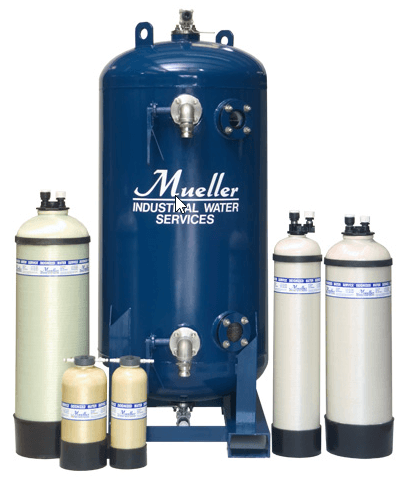
Pictured: the Mueller Industrial Water Services 30 ft³ bulk exchange tank shown with portable polishing tanks and smaller workers — the same modular lineup configured to whatever purity spec the reseller's customers require.
The Customer Profile
This program targets businesses that consume — or resell — deionized water as an input rather than an end product. They don't want to own, permit, or maintain a regeneration facility. They want clean water on demand and a margin opportunity. Typical buyers include:
- Chemical blenders and formulators producing cleaners, coolants, and concentrates that require low-conductivity water as a base.
- Distributors who supply window-cleaning, detailing, and pressure-washing operators needing spot-free rinse water.
- Cosmetic, nutraceutical, and food-grade producers needing consistent, contaminant-free dilution water.
- Battery, plating, and metal-finishing shops that buy DI water rather than run their own polishing loops.
- Labs, equipment-rental yards, and contractors who need a reliable, no-infrastructure source of pure water.
The Problem They Face
Most of these customers reach the same wall. Buying pre-bottled DI water by the case or jug is expensive at volume and clumsy to handle. Installing a permanent DI system means capital outlay, resin replacement, regeneration chemicals, wastewater handling, and ongoing maintenance staff. Neither option fits a business that simply wants to draw clean water and either use it or resell it at a markup.
They need a third path: industrial-scale purity, no infrastructure, and a cost structure predictable enough to build a resale price around.
The Solution: A Right-Sized Exchange Setup on a Flat Fee
The Mueller 30 ft³ DI exchange tank delivers high-purity deionized water on a simple exchange model. The setup is configured to the purity the application requires — from a straightforward exchange for general-purpose water, to a worker-and-polisher arrangement, to separate cation and anion beds ahead of a mixed bed where the most demanding low-conductivity specs apply. The customer draws water until the resin is exhausted, then swaps the spent tanks for fresh ones. There is no on-site regeneration, no resin handling, and no wastewater permitting. Maintenance, regeneration, and quality control stay on Mueller's side of the line.
The financial mechanic that makes this compelling is simple: the customer pays a predictable flat fee on each exchange, regardless of how profitably they deploy the water that setup produces. That fixed, knowable cost is the foundation of every resale margin calculation that follows.
Why a Flat Fee Changes the Math
When the input cost is fixed and predictable, the reseller controls the entire spread between that cost and whatever the market will bear. A properly sized 30 ft³ setup yields a large, consistent volume of finished DI water at the target purity. Spreading the flat fee across that full volume drives the effective cost-per-gallon down dramatically — and every gallon sold above that effective cost is margin.
Configuring to the purity the work actually requires keeps the reseller from over-buying capacity they don't need, while still guaranteeing the spec their customers pay a premium for — so the cost side stays lean and the value side stays high.
Illustrative Economics
The table below shows how the flat exchange fee is amortized across the water the setup produces, and how resale pricing compounds the return. Figures are illustrative to demonstrate the model — actual exchange pricing is provided separately by your Mueller representative.
| Lever | What It Represents | Effect on Return |
|---|---|---|
| Flat exchange fee | One fixed, known cost per exchange | Fixed — your only meaningful input cost |
| Setup sized to purity | Configured to the spec the work needs | No over-buying; guarantees sellable quality |
| Volume delivered | Large, consistent yield at target purity | Spreads the fee thin → low cost/gallon |
| Effective cost / gallon | Flat fee ÷ gallons delivered | Drops sharply as volume rises |
| Resale price / gallon | What blend/process customers pay | Set by market — you keep the spread |
| Margin multiple | Resale revenue vs. flat exchange cost | Often several times the exchange cost |
The takeaway: because the cost side is a predictable flat number and the revenue side scales with every gallon sold, the return on each exchange fee multiplies as the setup's volume moves into the market.
Worked Example (Model, Not a Quote)
Consider a chemical blender running a setup sized for their dilution spec, who resells the resulting DI water to three downstream accounts for their blend lines.
- They pay a predictable flat fee on each exchange — their entire input cost for the cycle.
- That fee is spread across the full volume the setup delivers, producing a low effective cost per gallon.
- They resell that same water at the going market rate for bulk DI water, which sits well above their effective cost.
- The gap between the two, multiplied across the full volume, returns several times the flat fee — with zero infrastructure on their side.
Stack multiple exchanges per month across a growing customer base, and a recurring flat fee becomes a repeatable, scalable revenue line.
Why This Works for the Reseller
Predictable Cost, Flexible Price
A flat exchange fee is the rare input cost a reseller can bank on. It doesn't fluctuate with resin markets or energy prices, so the reseller can publish stable bulk pricing to their own customers and protect margin.
No Capital, No Compliance Burden
There is no system to buy, no resin to replace, no regeneration chemistry, and no wastewater stream to permit. The barrier to entering the bulk DI water business effectively disappears.
Purity Matched to the Application
The setup is configured to the spec each use case demands — so the reseller delivers exactly the purity their blend and process customers require, which is the thing those customers actually pay a premium for, without paying for capacity they don't need.
Scales on Demand
Demand goes up, the reseller simply exchanges more capacity. There is no re-engineering and no capacity project — growth is a matter of swapping more units against the same flat-fee structure.
The Bottom Line
For a business that wants to sell bulk DI water for blends and process work, a Mueller 30 ft³ exchange setup — sized to the purity the job requires — turns a predictable flat fee into a scalable, high-margin revenue stream — without the capital, maintenance, or compliance load of owning a DI system. A predictable fee in; many gallons of resalable, premium-priced water out.
Next step: Contact your Mueller representative to configure a setup for your purity spec and to model the return for a specific volume and customer base.
Contact a Mueller Representative